We want to launch a private credit fund with a sustainability mandate. What is the minimum viable structure to attract institutional LPs?

DEAR JADE
THE ANSWER
Picture a boardroom in Mayfair. A fund manager has just finished a glossy, forty‑slide deck for a new 500 million dollar “sustainable credit” vehicle, rich with SDG logos, ESG integration slides, and carbon‑reduction metrics. The CIO of a tier‑one pension fund closes the deck and asks a quieter, more mechanical question: “I can buy liquid green bonds for a 4% yield. You are asking me to lock up capital in private credit for ten years. Where is my illiquidity premium—and if the underlying infrastructure defaults, who takes the first loss?” The fund manager hesitates. The pitch is over. The meeting just takes a few more minutes to end.
To understand why that happens—and why private credit dominated the closed‑door conversations at London Climate Action Week—you have to separate generic sustainable finance from private direct lending. Generic “sustainable finance” can sit comfortably in listed markets: liquid green bonds, climate‑themed equities, public funds with daily liquidity. Private credit lives elsewhere. It is bilateral or club lending to private borrowers, with sparse secondary markets and multi‑year lock‑ups. The whole point is that the capital is illiquid. If it does not show a clear yield premium over liquid green bonds, and a convincing story for how losses are contained, institutional LPs will not move.
This is one reason private credit has grown into a multi‑trillion dollar asset class. Banks, pushed by post‑crisis capital rules, have pulled back from complex, long‑dated infrastructure and corporate loans. Direct lending funds have stepped into the gap, financing everything from utility‑scale storage to off‑grid solar and brown‑to‑green retrofits that used to live on bank balance sheets. Alongside that growth, the mood has hardened. Analysts now openly discuss higher default paths in parts of the market. The “zero‑loss” phase is over; LPs assume some pain is coming and ask who has agreed to feel it first.
Inside that environment, the investment committee’s interrogation has become predictable. Every private credit proposal is quietly benchmarked against a portfolio of liquid green bonds: What is the extra net return for taking illiquidity and complexity? How long, in practice, is capital locked up? What default and recovery rates are plausible in this sector, and how do those losses work through the capital stack? If the manager cannot answer those calmly—with base and downside cases and a clear loss‑sharing story—the allocation dies in committee, even if no one ever says “no” out loud.

This insight was free. The next one is too. Annoying, right?
The hard truth: The structures that still clear this bar tend to share three hard-coded features.
To see why this matters, imagine a 400 million dollar fund with a 20% first‑loss tranche and 80% senior capital. If 10% of the underlying loans default and recover nothing, the first‑loss tranche is wiped out, but the senior LPs still get all of their principal back and can earn something close to their target yield. In other words, a relatively small pool of catalytic capital can absorb a surprisingly large amount of stress before institutional money is touched.
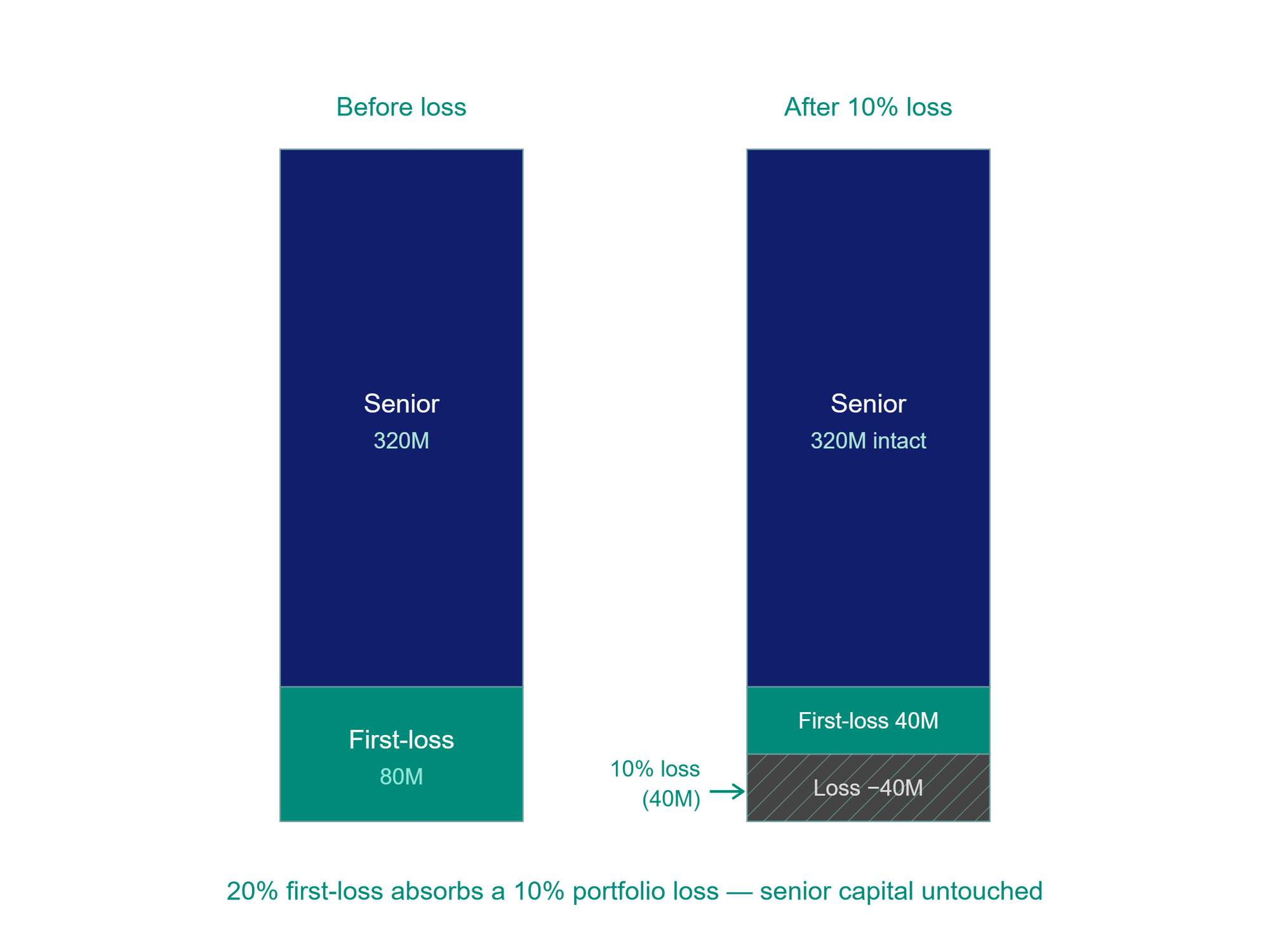
To see why this matters—even if you are not already living inside capital stacks—imagine a 400 million dollar fund with a 20% first‑loss tranche and 80% senior capital. If 10% of the underlying loans default and recover nothing, the fund loses 40 million dollars. That entire loss is absorbed by the first‑loss layer, which falls from 80 to 40 million. The 320 million of senior LP capital still gets all of its principal back and can earn something close to its target yield. At first glance, it seems insane to volunteer for first loss. For DFIs, donors and public guarantee schemes, that is the job: they trade a small, risk‑tolerant pool of capital for a much larger wave of private money and real assets on the ground.
First, a real first‑loss layer. The most credible transition and sustainability‑linked credit vehicles now build in catalytic capital—development bank guarantees, subordinated tranches from DFIs, or philanthropic pools—that are structurally positioned to absorb initial losses. This is not marketed as charity or impact theatre. It is presented as a defined protection layer that allows senior institutional capital to participate in frontier or transition risk without becoming the first shock absorber when defaults rise.
Second, hard, enforceable collateral. The strategies that resonate with cautious LPs look like infrastructure finance, not venture financing in disguise. They are secured against land, grids, industrial equipment, storage, or other physical assets that can be restructured, refinanced, or sold if a borrower fails. Recovery depends on something tangible, not just on future “green premium” revenue. In practice, this means conservative loan‑to‑value ratios, clear security packages, and enforceable step‑in rights over real‑world assets.
Third, climate performance wired into the loan. The market has moved beyond ESG reporting as a separate, narrative exercise. Leading managers are tying specific, independently verified climate or performance metrics to how the loan behaves over time—margin ratchets, coupon step‑ups or step‑downs, covenants linked to emissions intensity, efficiency, or transition milestones. The climate mandate leaves fingerprints in the cash flows. It is not just a section of the report; it is a feature of the economics.
Seen from the LP side of the table, this is the minimum viable structure that feels worth the lock‑up. A visible spread over liquid green bonds. A clearly defined first‑loss layer that absorbs early defaults before senior capital is hit. Claims on real assets that can be worked out in bad scenarios. And a transition story that shows up in the legal and financial architecture of the loans themselves, not just in the branding.
Institutional capital is not buying vibes. It is buying protected, illiquid yield in a world where default headlines around private credit are starting to appear. The managers who survive this shift are the ones who can sit in that Mayfair boardroom, look the CIO in the eye, and explain, in one unhurried arc, how they have priced the illiquidity, who is structurally wearing the first loss, and how the climate thesis is enforced over the life of the loan.
JADE SAYS
Institutional capital does not buy vibes; it buys protected, illiquid yield. Market data shows that successful sustainable private credit funds understand they are stepping into the void left by commercial banks. To win institutional allocations, they anchor a first-loss tranche to shield LP returns, secure physical collateral, and utilize margin ratchets to give their climate mandates strict financial enforcement. Prove the transition pays.
Have a question for Jade? Submit anonymously to info@jadeverse.io
We read all and may feature yours.
DISCLAIMER: On the Radar is an intelligence publication. This content is for informational purposes only and does not constitute financial, investment, or legal advice.


Comments ()