From Subsidy to Discipline: DFIs vs Private Credit

DEAR JADE
THE ANSWER
Imagine a solar developer in Nairobi. For the last five years, they have funded their expansion using subsidised 5% interest‑rate loans from a multilateral development bank. The catch? Each loan took 18 months of agonising bureaucracy, environmental audits, and political negotiations to clear.
Today, a tier‑one private credit fund approaches that same developer and offers to fund their next solar array in six weeks—but at a 15% interest rate. The developer panics at the massive spike in their cost of capital.
To the developer, this feels like predatory pricing. To the macroeconomic system, it is the definition of a maturing market.
Private credit flooding into traditional DFI territory is essential for the transition precisely because it forces the market to graduate from subsidised life support into rigorous commercial discipline. Here is how the mechanical handoff works:
The End of the Subsidy Trap
DFIs provide highly concessionary capital, but they are notoriously slow, bureaucratic, and capacity‑constrained. Private credit brings explosive velocity and flexibility, but it prices risk at brutal market rates (often 12–18% in emerging markets). The flood of private credit forces developers to abandon reliance on subsidised debt and build projects with unit economics strong enough to survive real commercial scrutiny.
Moving Up the Risk Curve
DFIs were never designed to be commercial banks; they were designed to be snow ploughs. Their mandate is to take on frontier, first‑mover risks that the private sector refuses to touch. When private credit steps in to fund operational, de‑risked solar farms, it systematically pushes DFIs higher up the risk curve—forcing them to deploy their scarce concessional capital into novel technologies (like green hydrogen) and untested geographies where they actually belong.
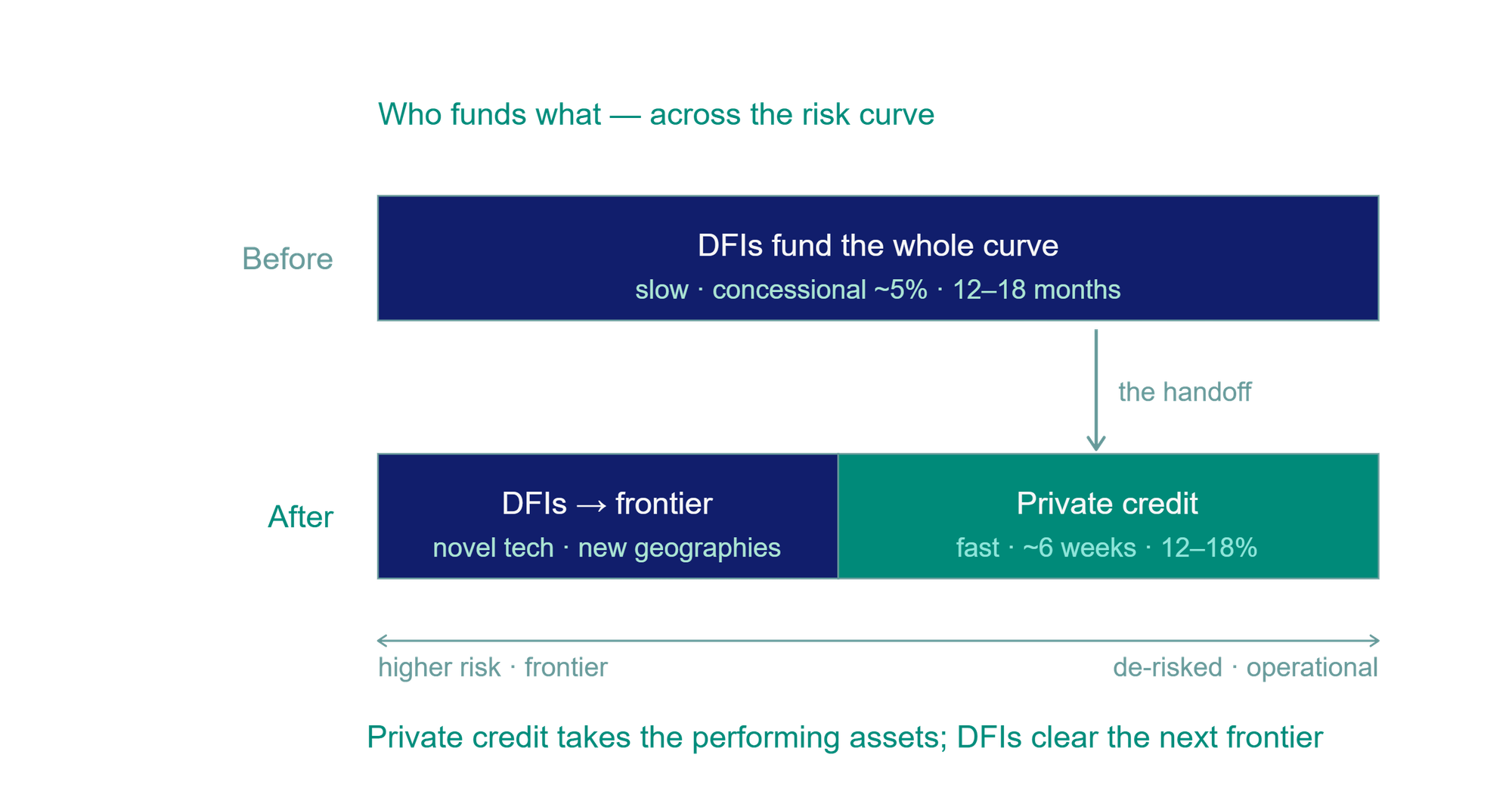
Private credit is not “repricing” the risk; it is charging the actual market rate for it. By taking over operational assets, private debt frees up DFIs to clear the next frontier. This is exactly how an asset class scales.

This insight was free. The next one is too. Annoying, right?
JADE SAYS
Private credit forces market discipline. It pushes DFIs higher up the risk curve to fund novel technologies, leaving operational, performing assets to commercial debt. A transition built entirely on subsidies cannot scale; commercial viability is the only sustainable exit strategy.
Have a question for Jade? Submit anonymously to info@jadeverse.io
We read all and may feature yours.
DISCLAIMER: On the Radar is an intelligence publication. This content is for informational purposes only and does not constitute financial, investment, or legal advice.


Comments ()